


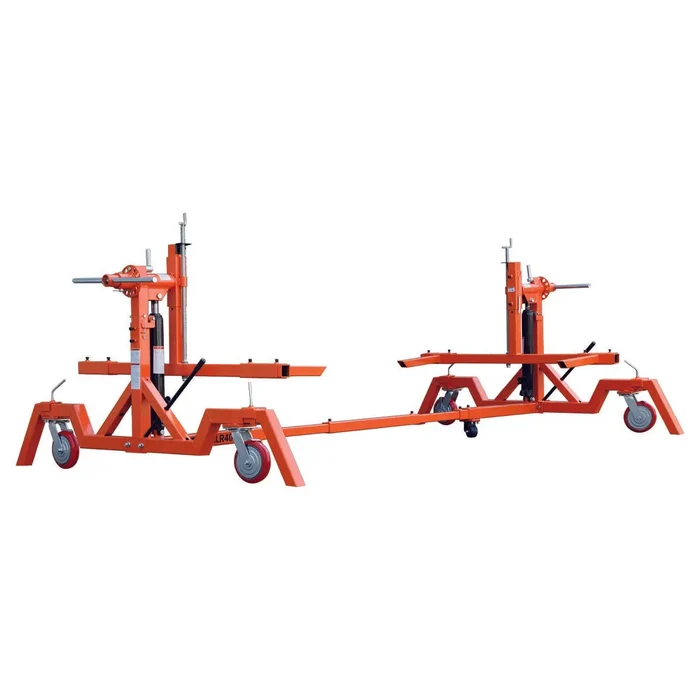
Summer projects reach the point where the floor becomes the obstacle
By late summer a great many American restoration projects have reached the stage where the body is stripped and the underside still has not been touched, because reaching it means crawling. A car rotisserie ends that stalemate by turning the shell instead of the person.
The device is a pair of heavy end stands on locking casters. Each stand carries a pivot head that clamps to the bumper mounting points or to fabricated brackets at the front and rear of the body. Between those two heads the shell hangs and rotates on a single axis.
Turning the shell converts awkward work into ordinary work
Floor pan replacement, rust repair, seam sealing, and undercoating are overhead jobs on jack stands and comfortable bench jobs once the body sits on its side. Welding improves most of all. A bead run downward is far easier to control than one run above the head.
Coating work benefits for the same physical reason. Material applied to a surface facing upward flows and covers as intended, while the identical coating sprayed overhead sags, runs, and lands on the person applying it. A car rotisserie is at heart a posture tool rather than a lifting tool.
The pivot has to sit where the weight already is
A stripped shell weighs several hundred pounds and carries that mass unevenly. The cowl and firewall region is heavier than the rear. When the pivot axis sits well below the center of gravity, the body behaves like a pendulum and swings hard to whichever side starts lower.
Set the axis at or slightly above that center and the assembly becomes close to neutral, turning under hand pressure and staying wherever it is left. Every serious design offers height adjustment at both ends for exactly this reason. The adjustment happens before the first full rotation.
Finding the balance point is deliberately slow work
Balancing proceeds in small steps. The shell is raised slightly, released against the locking mechanism, and watched for any tendency to roll. Mounting height is then changed a little at a time, until the body holds any position it is given.
Position along the length matters as well. A body mounted off center loads the two stands unequally. A four thousand pound rating on a car rotisserie describes the pair of stands working together, not one of them carrying most of a badly positioned shell.
Everything that can pour out must come out first
A body turned onto its side will empty whatever remains inside it. Fuel, engine oil, coolant, brake fluid, and washer fluid all belong in drained containers before the first rotation on a car rotisserie. The battery leaves with them, because a tipped battery releases acid.
Glass is the next removal. Windshields and rear glass are bonded panels held in tension, and rotating a shell flexes the opening enough to crack them. Doors, seats, and interior trim come out as well, both to cut weight and to stop loose parts falling during rotation.
Nothing turns until the lock is deliberately set
Rotation control separates a managed turn from an accident. A geared handle or hydraulic assist lets one person move the shell slowly, while a pin or ratchet holds the chosen angle. That lock is engaged before any tool, grinder, or torch touches the body.
The floor deserves equal attention. Locking casters make a car rotisserie easy to reposition between jobs, but a shell turning on a sloped or broken slab can start to travel. The casters are locked, and the working area is kept flat, clear, and free of cords.
What ends up mounted between the two stands
• Unibody shells: brackets at bumper mounting points
• Separate frames: clamped directly to the rails
• Truck cabs: fabricated adapters at factory mounts
• Stripped bodies only: no drivetrain, glass, or fluids
The gains and the things it will not forgive
• Strength: underside work performed standing rather than lying
• Strength: welding and coating done in easier positions
• Limit: mounting and balancing consume genuine setup time
• Limit: unbalanced or undrained shells turn dangerous quickly
Serious metal work keeps moving into smaller shops
Home builders and small specialist shops now take on structural repairs that once went to dedicated body facilities. They need equipment sized for a two-car garage and one pair of hands. A car rotisserie qualifies precisely because it replaces extra helpers with careful geometry.
That is why the automotive shop equipment that TMG Industrial supplies now reaches private restorers in home garages as readily as it reaches established commercial body shops.
