


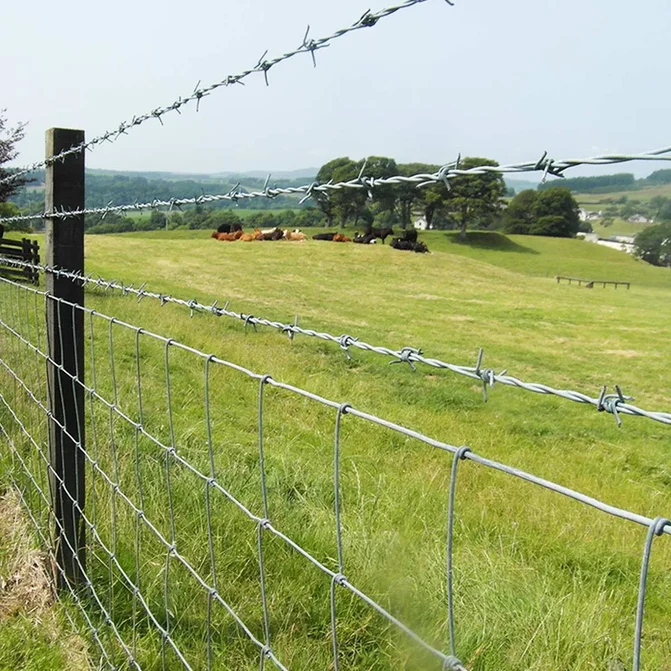
Fence rolls all look the same until something gets out
Standing in a yard, one roll of woven wire looks much like the next, and the difference only reveals itself when a calf pushes through or a season of weather leaves a line sagging. Choosing a farm fence well means reading the three numbers printed on the label rather than judging by appearance.
Those numbers are height, wire gauge, and spacing, and each answers a different question. Height decides what the fence contains, gauge decides how long it lasts under pressure, and spacing decides what can and cannot pass through the mesh itself. Getting a farm fence wrong is expensive in labor rather than in wire.
Height is chosen for the animal, not the fence line
A forty-seven inch fence stands just under four feet, which is the working height for cattle, horses, and most livestock that lean and push rather than jump. It is tall enough that an animal cannot get its shoulders over the top. Different stock change that calculation. Sheep and goats climb rather than lean and need tighter mesh low down, while deer clear four feet without effort, so a farm fence chosen for cattle is not automatically the right answer elsewhere.
Gauge is a thickness number that runs backward
Wire gauge confuses buyers because a smaller number means thicker wire. Twelve and a half gauge is a heavy agricultural wire, noticeably stouter than the lighter wire used in garden and utility fencing, and it resists stretching under a sustained push.
That thickness is what decides whether a line stays tight across years. Light wire deforms permanently the first time cattle lean on it, and once a section has stretched it never comes back, leaving a permanent low spot in the run. Wire gauge is where a farm fence either holds its line or slowly gives up.
Vertical spacing decides what fits through
The vertical wires that cross the horizontal lines are set at intervals, and six inch spacing produces a mesh tight enough that a calf cannot push its head and shoulders through between them. Wider spacing costs less and holds larger animals perfectly well, but it lets young stock work through gaps that adults cannot even test. Anyone running cattle that calve in the field is buying the tighter spacing for that reason alone.
Galvanizing is what decides the years, not the strength
Wire is strong on the day it is installed, and that says nothing about the years afterward. What determines whether a fence is still standing in fifteen years is the zinc coating over the steel, which corrodes slowly in place of the wire beneath it.
That matters especially in a Canadian climate, where a fence line goes through repeated wetting, freezing, and snow load every year. A grazier near Red Deer replaced ungalvanized wire twice before installing coated farm fence that has now outlasted both.
Tension is what turns a roll into a working fence
Even the best wire performs badly if it is hung loosely. A properly strained line carries a push along its length to the braced corner posts, spreading the load instead of concentrating it where the animal is leaning.
This is why corner and end assemblies matter more than the line posts between them, and why they are braced rather than simply driven. A hundred meter roll pulled tight against a weak corner simply drags that corner out of the ground over the first season.
Reading a roll before buying it
• Height: match the stock, not the neighbor’s fence
• Gauge: lower number means thicker wire
• Spacing: tighter mesh holds young animals
• Coating: galvanizing decides the service life
Where woven wire wins and where it does not
• Strength: contains stock that push and lean
• Strength: one continuous barrier along a run
• Limit: climbing and jumping animals need more
• Limit: only as good as the corner assemblies
Weighed against strands of barbed or electric wire, woven mesh costs more per meter and takes longer to strain, and returns a barrier that holds young stock and keeps its shape without depending on a charger staying live.
Fencing decisions are being made for longer horizons
As the labor to build a fence outgrows the price of the wire itself, producers increasingly buy the heavier gauge and better coating on the first installation rather than planning to redo the line within a decade.
That longer view is why the fencing supplies that TMG Industrial stocks are specified by gauge and coating rather than sold on roll length alone.
